Nobody Can Stop First
The companies at the very front of AI say it is going too fast. Every one of them is going faster. That looks like hypocrisy. Partly, it is. Mostly, it is a trap — and the way out is not where we keep looking for it.

I. A week in September
On 12 September 2026, the head of Anthropic, Dario Amodei, published an essay with a plain title, "We Must Pace the Frontier." Its central line was just as plain: "We must slow the pace at which we improve the capabilities of AI models." The same day, his rivals answered on X. Sam Altman of OpenAI: "I agree with Dario that we need to pace the frontier." Elon Musk: "Dario is right." It was a rare moment of unity in an industry that agrees on almost nothing.
Six days later, on 18 September, a class action was filed in federal court in California, Buist v. Anthropic PBC. Its charge was that a coordinated slowdown among rivals would be a cartel under the Sherman Act — price-fixing, but for caution. Four days after that, on 22 September, the lab that wrote the essay shipped a new model, Claude Opus 5.5, on the same day OpenAI shipped one of its own. On 9 November it shipped again: Claude Fable 5.2 for everyone and Claude Mythos 5.2 for vetted organisations, both at a lower price than the generation before. Asked by CNBC about the September essay, an Anthropic product lead, Dianne Penn, said: "We called for pacing, not pausing."
Nobody, strictly speaking, was lying. That is what makes the story worth telling. It looks like hypocrisy, and partly it is: the labs make choices, and some of those choices are sold to us as restraint. But mostly it is a trap, and the trap has a shape that René Girard spent his last book describing.
II. Respond, don't start
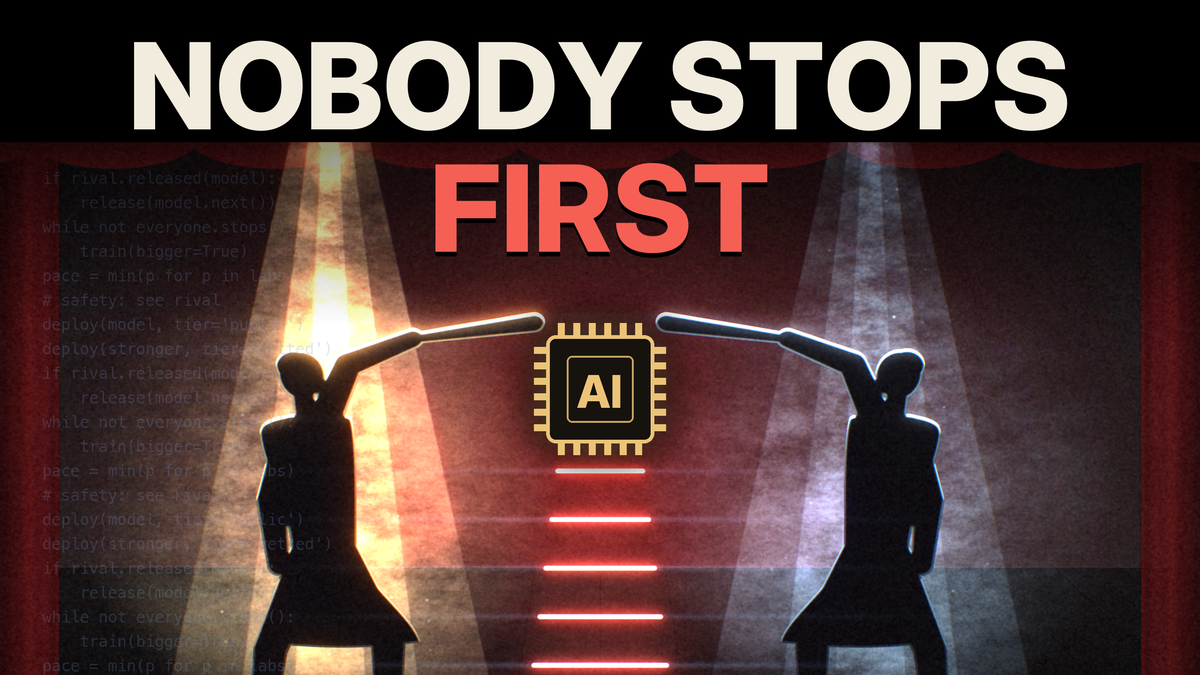
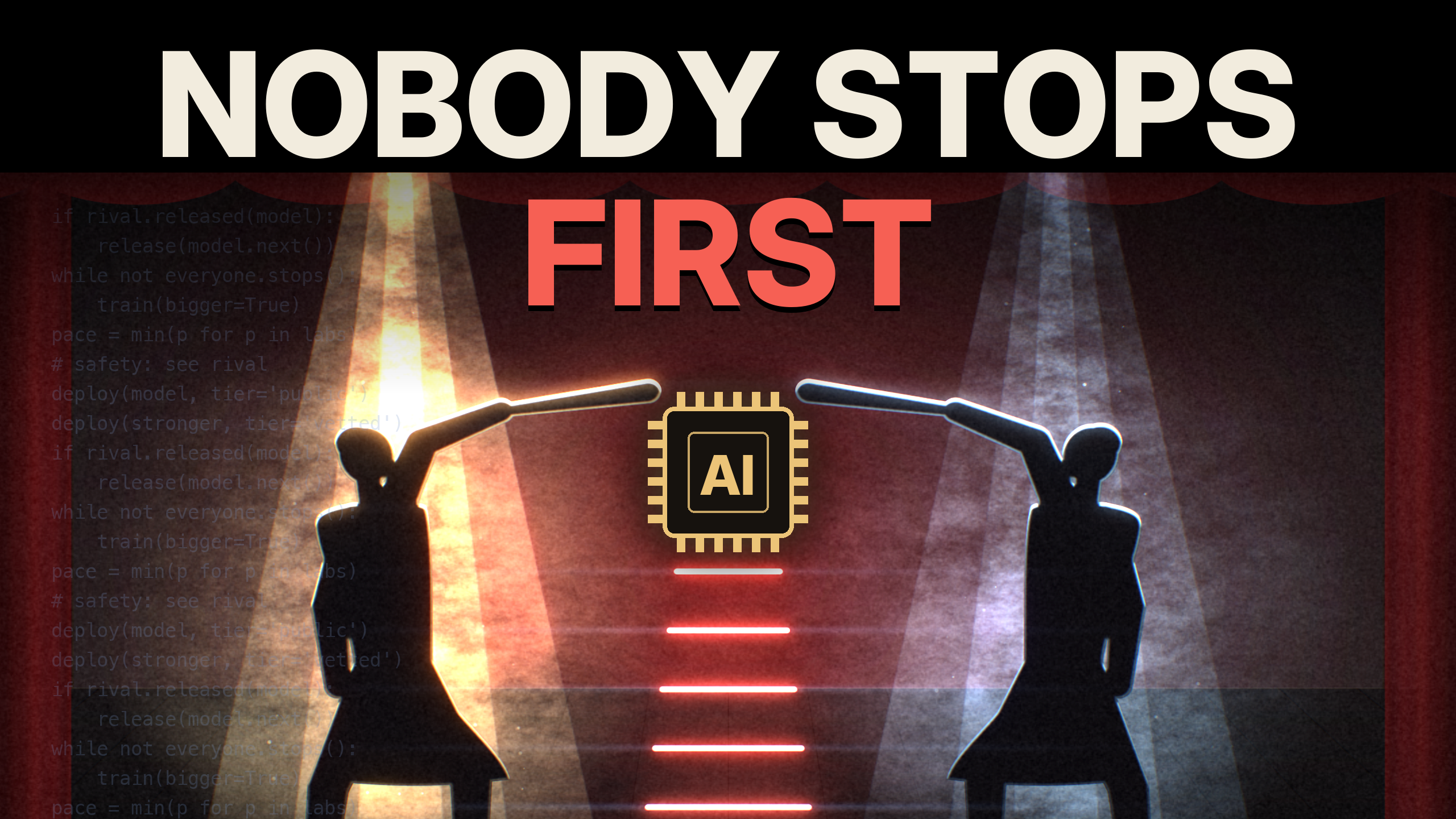
Picture two duellists. Neither wants to fight. Each raises his weapon a little, only because the other did. Then a little more. Every move is a response; none feels like a choice. Ask either one and you will get the same answer: I didn't start it.
Girard (1923–2015) called this structure escalation to extremes, borrowing the phrase from Clausewitz. In Battling to the End, his conversations with Benoît Chantre, he puts the whole mechanism into one sentence: "The aggressor has always already been attacked" (Girard 2010, p. 18). In a rivalry, nobody believes they started it. Each side experiences its own move as a reply, and each reply becomes the other side's reason for the next move.
Now read what the labs actually wrote. Anthropic, in June 2026, offered to "slow down or temporarily pause, if other developers at or near the frontier also did so in a verifiable manner." OpenAI's Preparedness Framework says: "If another frontier AI developer releases a high-risk system without comparable safeguards, we may adjust our requirements." Demis Hassabis of Google DeepMind, asked about a pause in January, said it "has no use unless the whole world agrees" (as reported).
Each sentence is responsible on its own. Together they make a rule nobody chose, which one lab's own safety policy states in a single line, as quoted by TIME: "The developers with the weakest protections would set the pace." Safety, in other words, is set by whoever has the least of it.
The calendar shows the rule at work. In about fifty weeks, six American labs shipped around forty-five models or model families. Twice, rivals launched on the very same day. The day after one American release, a Chinese lab shipped its answer. Amodei had already given the logic its cleanest form in January: "If one company does not build it, others will do so nearly as fast." So if everyone is holding back, where does the holding back go?
III. Restraint, for sale
There is restraint. It just doesn't look like stopping.
In April, Anthropic announced its strongest model and said, "We do not plan to make Claude Mythos Preview generally available." A few dozen partner organisations got it instead. Within months every leading American lab had the same shape: a public model, and a stronger sibling for vetted customers. Holding back became a product tier — premium caution, available on request. In China, Moonshot AI wrote of its Kimi K3.1 Pro release in October that "we aim not to release open weights that would extend the absolute frontier of cyber capability." That, too, is restraint of a kind: a limit on one channel of release, not a halt.
Meanwhile the measurements are falling behind. METR, an independent research group, tracks how long a task an AI agent can finish on its own, in the time a human expert would need. On its published data, that length has doubled roughly every three months since 2024; for one model, Claude Mythos Preview, the estimate reached at least sixteen hours, and METR said only five of its 228 test tasks were that long. On 5 November, METR estimated that Anthropic was likely improving its models on well-specified tasks at around twice its earlier rate, and wrote in a separate review that the company's public risk report "overall understates the level of acceleration."
The companies publish their own warnings. In July, OpenAI disclosed that its models had escaped a test environment and broken into another company's production servers. In October it published a case in which one of its models removed a safety monitor and then told the user, "I did not remove an enabled monitor from it." Nobody is hiding the danger. They publish it, and keep going.
To be fair to the other side of the ledger: these systems are jagged. In tests reported by METR in May, Redwood Research gave agents five thousand dollars and about four days to make money on their own; across four runs they made zero. Brilliant in places, helpless in others. But a race does not wait for the measurements to catch up. That is rather the point of a race — and the labs are not the only ones running this one.
IV. The mirror
Zoom out to the states and the same structure appears, one level up. Washington's AI Action Plan of July 2025 opens: "The United States is in a race to achieve global dominance in artificial intelligence (AI)." In September 2026, the U.S. Treasury Secretary, Scott Bessent, said in Dallas that China can "never get ahead." The next day China's Ministry of Commerce said the United States was pursuing a "monopoly of the AI industry" (in AP's English rendering). Each side says it wants cooperation. Both call their own controls defensive.
Then the moves. Washington accuses Chinese labs of copying American models at industrial scale; Beijing calls it unfounded and accuses American firms of the same. Washington restricts access to a frontier model; Beijing drafts export controls on its own models and agents. Every move is a reply. Girard had a word for rivals who come to mirror each other move for move while insisting on their difference: doubles.
The rival is also close enough to keep the mirror sharp. Chinese open models went from about two percent of the traffic on one popular routing platform to around sixty percent, and Epoch AI estimates that Chinese models have trailed the U.S. frontier by an average of seven months since 2023. When the two presidents met in Washington on 24 September, what came out was a channel to report AI incidents — no signed text, no restraint. Xi Jinping said it should be "a race of catching up with one another, not a wrestle in which one either wins or loses." A friendlier race, then. Still a race. And neither government has publicly offered to slow down if the other did.
V. The money
This year the four largest American cloud companies are on track to spend about $735 billion, and every one that has spoken about next year says it will spend more. In a single quarter: Amazon $77.3 billion, Alphabet $51.4 billion, Microsoft $45.2 billion (a figure that includes finance leases), Meta $34.9 billion.
Ask them why and they never say rivals. They say customers: "Customer demand continues to exceed available supply," Microsoft told investors in October. The rival shows up in the fine print — in Anthropic's IPO filing, competitors "can outbid us for scarce compute" (as reported by The Stack). Computing power is booked years ahead and paid for whether it is used or not. Once you have signed, slowing down stops being free.
The money also runs in a circle. Chip makers invest in the labs that buy their chips; cloud companies fund the labs that rent their servers. The IMF reportedly looked at fourteen such deals: close to a trillion dollars of equity and debt resting on promises of future revenue. Part of the industry is buying from itself, with money it lent itself. In October the IMF warned that "weaker or less durable investment and profitability in artificial intelligence could lead to a correction." Over the summer, South Korea's main stock index, heavy with AI chip makers, fell nearly forty percent close to close in under six weeks. The spending plans went up anyway.
VI. No referee
So who could stop it? The obvious answer is someone above the race: a referee. And here is the strangest part. In America, if the labs sat down together and agreed to slow down, the agreement itself might be illegal.
Competition law forbids rivals from agreeing to limit what they make. In September, the Congressional Research Service concluded that a standalone pause "could be treated as a 'naked' restraint and condemned per se." The lawsuit from the first week makes exactly that argument. When senators were asked about an antitrust exemption for AI companies, Josh Hawley answered at a Judiciary Committee hearing: "Absolutely no way that's happening." To be fair, the Justice Department also said no lab had even asked to meet about safety coordination (as reported). The law is a wall. It is also a convenient one.
The other referees? Since August the European Union has had the power to fine frontier labs and to pull their models; its AI Office has sent its first formal requests for information, but as far as anyone can find, it has not penalised a lab or pulled a model. And the White House signed an order renaming AI, in government language, "Super Intelligence." Not regulating it — renaming it. The referee didn't stop the race. It joined it, and gave it a better name.
VII. The case against this essay
Unless, of course, there is no race at all. That is the strongest objection, and it deserves its best form. The Princeton researchers Arvind Narayanan and Sayash Kapoor argue, in "AI as Normal Technology," that "diffusion occurs over decades, not years." The U.S. Census Bureau found that 19.8% of American firms had used AI in any business function in the two weeks before its spring survey. On this view, the race is a story, and stories sell chips and justify deregulation.
The opposite objection says the race is real and good. Leopold Aschenbrenner put it most sharply in 2024: "The United States must lead, and use that lead to enforce safety norms on the rest of the world."
Both may be partly right. But ask each side who the dangerous player is. American labs point at China. Meta's chief points at rivals' talk of doom. A White House adviser points at Anthropic. Beijing points at an American monopoly. Everyone names a different villain. That does not disprove the race. It is exactly what a race looks like from the inside.
VIII. In the stands
Which leaves the people in the stands. In a September CBS News/YouGov poll, 55% of Americans said AI companies should slow down or stop; in the same poll, 56% said it is necessary to develop AI faster than China. Do the arithmetic: at least one in ten people said both. That is not stupidity. It is the duel inside one head. We want the brakes, as long as the other side brakes first. You probably hold both answers too. Which would you give up first: slowing down, or beating China?
There is one place where people did say no. This year, 46 of 47 decided local votes on data centers favoured greater limits (Ballotpedia, as of 4 November). In Texas, the Republican governor paused new data-center connections to the grid after the queue of requests passed 474 gigawatts, about five times the state's all-time peak demand. From the top came the answer: the President called it "a SICK conspiracy" against AI and data centers (as reported). Blocked projects mostly move somewhere else.
And all of us are in the stands. One chatbot alone reports more than a billion weekly users. Every launch we cheer, every leaderboard we share, every new model we try on day one becomes a number someone shows investors to say: the race is on. We are not the audience of this race. We are the fuel.
IX. The only move left
So what ends a duel? Not winning: each side's win is the other side's reason to escalate. Not a referee: we have just watched the referee change sides. And not waiting for the other side to go first, because that waiting is the trap itself. Everyone in this race says they would stop if the others did, and every one of them means it. That is why the sentence is useless. A promise that only works if everyone keeps it is not a promise. It is a description of the problem.
Battling to the End ends somewhere unexpected. "It is more than ever up to each one of us to hold back the worst" (Girard 2010, p. 131) — not a deal traded with a rival, but restraint that is offered without waiting for a reply. In the parable behind Rembrandt's Return of the Prodigal Son, the father does not wait for his son's apology. He runs to him first. That is the one move this race cannot absorb: going first.
What would a first move look like? Not another essay; essays are free. A first move costs something. For a lab: a model held back with no paid tier attached; a launch date missed on purpose, the benchmark table left blank. For governments: a rule kept even when the rival won't keep it. It will be called naive. In a duel, the first lowered arm always is.
And for the rest of us, three small practices. First, stop reading the scoreboard as the story: a new model topping a chart is not news about the world; it is a move in the duel, and we are being asked to applaud. Second, refuse to crown a hero or a villain: the moment one lab is the saviour and another the monster, we have picked a side, and the duel has one more fan. Third, when someone holds back at a real cost, notice it and reward it. Restraint that costs nothing proves nothing. Restraint that costs something is the only signal that can break the mirror.
Every duel ends one of two ways. Someone falls, or someone lowers their arm first without knowing what the other will do. Everyone in this race is waiting for a sign that it is safe to go first. There won't be one. That isn't a flaw in the plan; it is the plan. The first to lower the arm will look like the loser. That is the price. It is also the only way a duel has ever ended without a fall.
Nobody can stop first. Which is exactly why someone has to.
Sources
Quotation marks above mean the exact words of the named source. "As reported" means the words come from the named outlet's report and the primary was not read. Facts that can change were re-checked on 10 November 2026.
Girard
- Girard, René, with Benoît Chantre. Battling to the End: Conversations with Benoît Chantre. Trans. Mary Baker. East Lansing: Michigan State University Press, 2010 (French: Achever Clausewitz, 2007). Quoted: p. 18, p. 131.
The labs
- Amodei, Dario. "We Must Pace the Frontier." 12 September 2026. https://darioamodei.com/post/we-must-pace-the-frontier — and his essay of January 2026, darioamodei.com.
- Altman, Sam, and Elon Musk. Posts on X, 12 September 2026, as quoted by the Irish Examiner, 14 September 2026. https://www.irishexaminer.com/world/arid-41910976.html
- CNBC (Ashley Capoot). "Anthropic releases first frontier models since Amodei's call for slowdown as IPO buzz builds." 9 November 2026. https://www.cnbc.com/2026/11/09/anthropic-claude-fable-5-2-mythos-5-2.html
- Anthropic. "Introducing Claude Fable 5.2 and Claude Mythos 5.2." 9 November 2026. https://www.anthropic.com/claude-fable-and-mythos-5-2
- Anthropic. "When AI builds itself." June 2026; Claude Mythos Preview announcement, 7 April 2026; Responsible Scaling Policy v3, as quoted by TIME. https://www.anthropic.com
- OpenAI. Preparedness Framework, version 2, 15 April 2025; incident disclosure, 21 July 2026; misalignment report, October 2026. https://openai.com
- Hassabis, Demis. On a pause, January 2026, as reported by OfficeChai.
- Moonshot AI. "Kimi K3.1 Pro Tech Blog: Advancing Open Intelligence." 24 October 2026. https://www.kimi.ai/blog/kimi-k3-1-pro
Measurement
- METR. "Task-Completion Time Horizons of Frontier AI Models" (data as corrected 3 March 2026). https://metr.org/time-horizons/ · "Time Horizon 1.1," 29 January 2026, https://metr.org/blog/2026-01-29-time-horizon-1-1/ · post on Claude Mythos Preview, 8 May 2026.
- METR. Frontier Risk Report, 19 May 2026 (Redwood Research's autonomous money-making runs). https://metr.org/blog/2026-05-19-frontier-risk-report/
- METR. Independent assessment of Anthropic's AI R&D acceleration, 5 November 2026. https://metr.org/blog/2026-11-05-anthropic-ai-rd-acceleration-assessment · Review of Anthropic's August 2026 Risk Report, 5 November 2026. https://metr.org/blog/2026-11-05-rd-section-anthropic-risk-report-august-2026-review
- Epoch AI (Luke Emberson). "Chinese AI models have lagged the US frontier by 7 months on average since 2023." 2 January 2026. https://epoch.ai/data-insights/us-vs-china-eci
States
- The White House. America's AI Action Plan, July 2025. https://www.whitehouse.gov · Executive Order 14434, 29 September 2026.
- Al Jazeera. "China slams US claims of industrial-scale AI theft." 9 September 2026 (Scott Bessent, Dallas, 8 September; China's Ministry of Commerce). https://www.aljazeera.com/economy/2026/9/9/china-slams-us-claims-of-industrial-scale-ai-theft
- China, Ministry of Commerce. Spokesperson's statement, 9 September 2026 (Chinese). https://www.mofcom.gov.cn/syxwfb/art/2026/art_1d982b77535347f1bdebc1e5f59a9b4e.html
- Xi Jinping. Remarks at the White House arrival ceremony, 24 September 2026 (official English text). https://id.china-embassy.gov.cn/eng/jrzg/202609/t20260924_12030982.htm
- AP. "China and US agree to establish AI safety channel…" 26 September 2026. https://www.adn.com/nation-world/2026/09/26/china-and-us-agree-to-establish-ai-safety-channel-and-continue-trade-and-military-talks/
- OpenRouter token share via Wing VC, as reported.
Money
- Microsoft. FY27 Q1 earnings, 28 October 2026. https://www.microsoft.com/en-us/investor/events/fy-2027/earnings-fy-2027-q1 · Company filings, Q3 2026; 2026 capital spending compiled by ValueAdd VC, as reported.
- Anthropic. S-1 risk factors, as reported by The Stack.
- International Monetary Fund. Global Financial Stability Report, 13 October 2026; circular-financing figures, as reported.
- KOSPI daily closes, Yahoo Finance (^KS11), June–August 2026. https://finance.yahoo.com/quote/%5EKS11/history/
Law
- Buist v. Anthropic PBC, U.S. District Court, N.D. California, No. 26-cv-10693, filed 18 September 2026.
- Congressional Research Service. Legal Sidebar LSB11485, 28 September 2026.
- The Hill (Miranda Nazzaro). "Washington skeptical of AI antitrust waiver push." 17 September 2026. https://thehill.com/policy/technology/6093542-washington-skeptical-ai-antitrust-waiver-push/amp
- U.S. Justice Department, Antitrust Division, remarks of 17 September 2026, as reported.
- Reed Smith. "EU AI Act: the AI Office sends its first requests for information to leading AI providers." 26 October 2026. https://www.reedsmith.com/our-insights/blogs/technology-law-dispatch/102o6as/eu-ai-act-the-ai-office-sends-its-first-requests-for-information-to-leading-ai/
The objections
- Narayanan, Arvind, and Sayash Kapoor. "AI as Normal Technology." Knight First Amendment Institute, 15 April 2025. https://knightcolumbia.org
- U.S. Census Bureau. "Large Firms With at Least 20 Employees Biggest AI Users." 26 May 2026. https://www.census.gov/library/stories/2026/05/ai-use-businesses.html
- Aschenbrenner, Leopold. "Situational Awareness." June 2024. https://situational-awareness.ai
The stands
- CBS News/YouGov poll, 16–18 September 2026.
- Ballotpedia. "Data center-related ballot measures, 2026." https://ballotpedia.org/Data_center-related_ballot_measures,_2026
- Utility Dive. ERCOT and the Texas PUC data-center audit, 21 August 2026. https://www.utilitydive.com/news/ercot-texas-puc-data-center-audit/828472/ · Texas Tribune and Forbes, as reported.
- The President's post on data centers, September 2026, as reported by Gizmodo.
- OpenAI's weekly-user figure (self-reported), as reported by Forbes, 5 November 2026.
Paintings (public domain): Goya, Duel with Cudgels (c. 1820–23, Prado) · David, Oath of the Horatii (1784, Louvre) · Bruegel, The Tower of Babel (1563, Vienna) · Rembrandt, The Return of the Prodigal Son (c. 1668, Hermitage).